Creative writing, photography, opinions, random thoughts and pretty much whatever I feel like!
Category Archives: Lifestyle
Greg Glazebrook @ GMGPhotography
Almost Full
This image of the “Almost Full” Hunter Moon was taken on October 26th in my driveway in Waterloo, Ontario. It was captured using the Celestron AZ102 Refractor Telescope and my Pixel 7 Pro’s rear camera. The telescope is Celestron’s next to bottom offering that I purchased on sale at Costco. There are much better telescopes out there but this one is more than adequate for the kids to see the moon and planet although the planets are quite small, and at that size there is a lot of natural earth shake transferred to the unit, but they are visible.
Image was captured on October 26th in Waterloo, Ontario Equipment: Celestron AZ 102 Refractor Telescope and Google Pixel 7 Pro (Rear Camera) Camera Settings: 6.81mm | 1/138 sec. at ƒ/1.9 | ISO200. Additional processing including starfield rendering via Adobe Lightroom/Photoshop.
It was hot as Sadie stepped into the barn. Her grass-fed organically raised family, back from a day in the pasture. The herd lowed as she pulled on her boots and gloves. Bessie was waiting as always for Sadie to set the stool at her side. A few fruitless tugs and then relief as milk began to flow from her engorged teats.
There were pumps, feed and other technology designed to increase yield and productivity, but Sadie found something relaxing about the sound of milk ringing against the interior. “Wholesome, sustainable farming, our commitment freshly expressed into every can.”
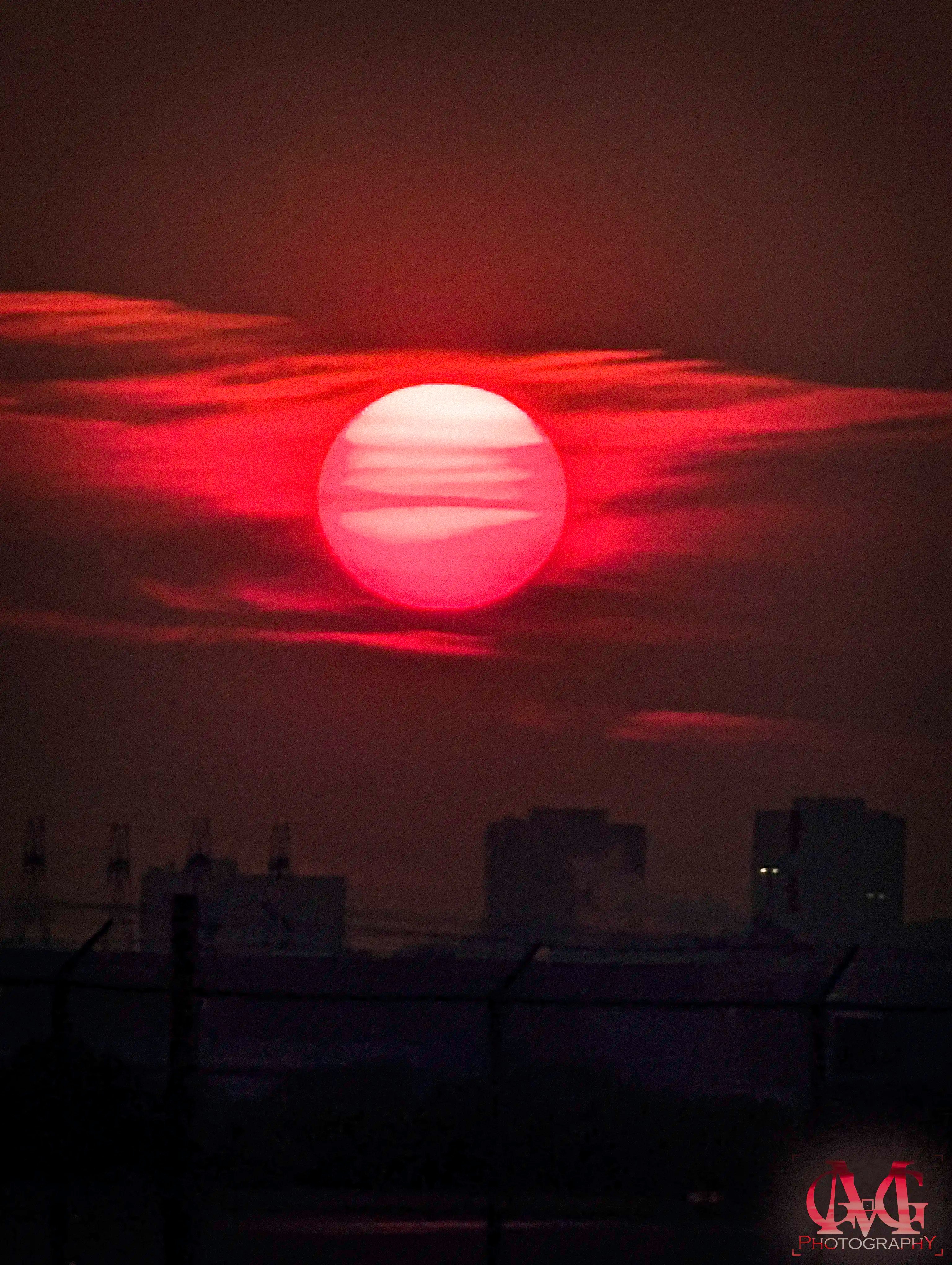
This image was shot over Lester B. Pearson International Airport near Toronto, Ontario at the peak of the northern wildfire smoke cloud that enveloped large portions of the Eastern Seaboard in June 2023. The image itself is an underdeveloped mess that despite its obvious flaws conveys an ominous window into a dystopian future.
Image was captured in June 2023 near Lester B. Pearson International Airport, Mississauga, Ontario Equipment: Google Pixel 7 Pro (Rear Camera) Settings: 19mm | 1/853 sec. at ƒ/3.5 | ISO11. Additional processing via Adobe Lightroom/Photoshop.
Unknown / Post-processing by Greg Glazebrook @ GMGCreative
Dad’s Lessons
The summer of ’63. Jinny and I talk about running off in that old Sharknose Ford. God knows what we’d have gotten up to in the flatbed. Me, a sixteen-year-old life support system for a boner and Jinny completely smitten. Nothing good could have come from two teenagers high on the hormones of youth.
“Patience,” he’d say gripping the keys in his dirt-stained hands. “You’ll be the driver someday.”
God knows where we’d be if he’d let us run wild. Dad’s gone but Jinny and me still look something spectacular sitting in the front seat of that old truck.
Unknown / Composite image created by Greg Glazebrook @ GMGCreative
Every week Fandango over at This, That and the Other posts a provocative question. This week’s question is…
“Do you think that the metrics the Academy Awards will start applying in 2024 regarding the composition of at least 30% of the cast and crew by under-represented groups in order for a film to even qualify for the Best Picture Oscar nomination is appropriate? Or, do you share Richard Dreyfuss’ opinion that because filmmaking is an art form, imposing such criteria in order for a film to even be considered for an Oscar is inappropriate?“
It is as ridiculous as the publishing world rewriting books to conform to today’s politically correct woke-driven standards. It is a form of censorship that we cannot allow to happen. I believe the best people applying for the position should be employed. I’m not naive, I fully understand that there are bigoted factions in society and sometimes affirmative action initiatives are appropriate. There are other ways to ensure a representative workforce. Stifling art is not the place it should be applied.
Art must be judged on its merit, not on a headcount of arbitrarily delineated categories of people. Salman Rushdie said it best of the literary world at the 2023 British Book Awards when he was talking about publishers re-writing works by authors such as Ian Fleming and Roald Dahl. “Books have to come to us from their time and be of their time, and if that’s difficult to take, don’t read them. Read another book, but don’t try and remake yesterday’s work in the light of today’s attitudes.”
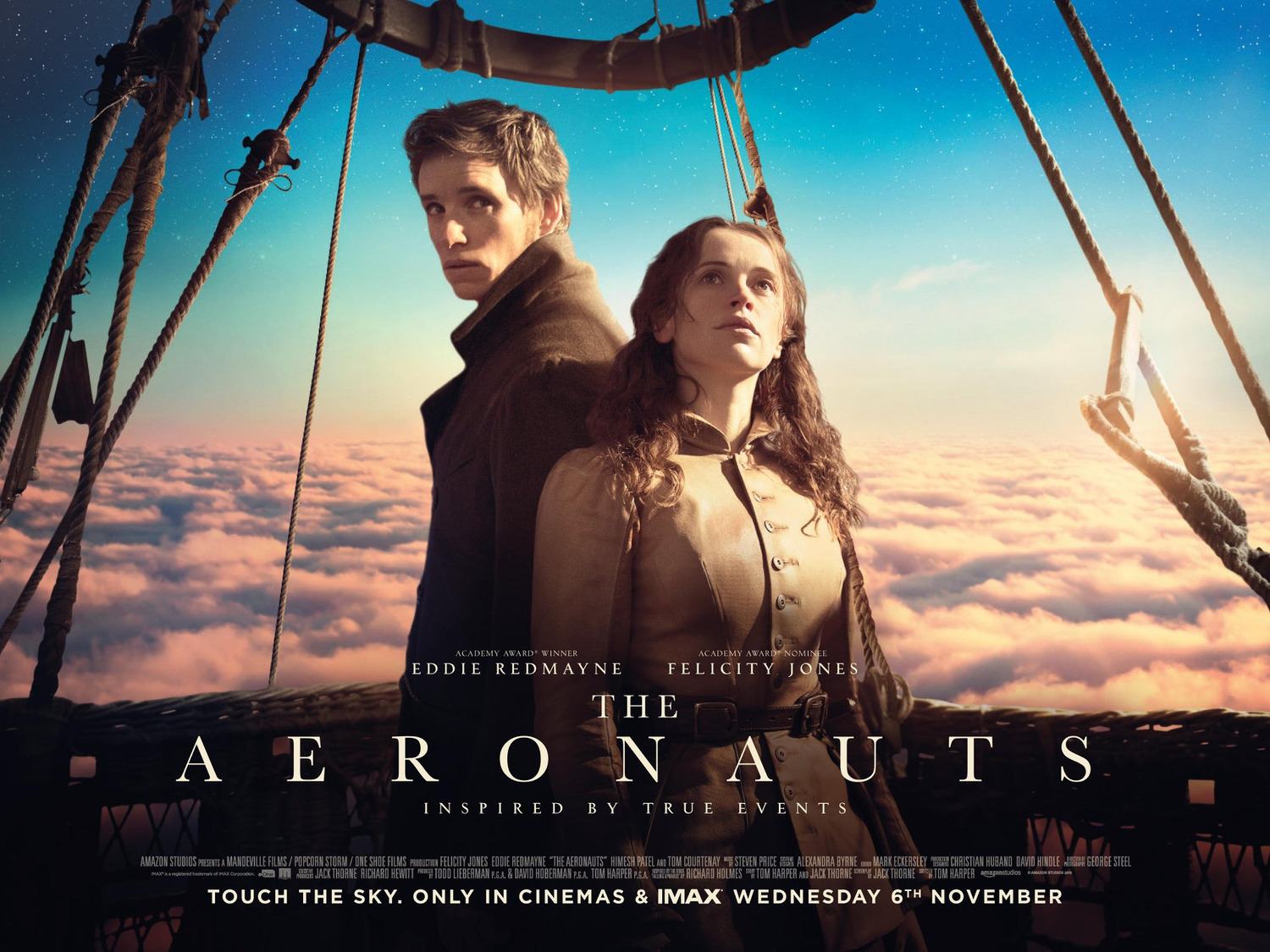
While Hollywood may not be re-editing or updating older works there is a push to rewrite the screenplays of the stories Rushdie talks about to conform to today’s rules. I point to the example of The Aeronauts, a fictional film based on the true history of scientists James Glaisher and Henry Tracy Coxwell. When the screenplay was being written and the cast chosen there was a conscious effort to replace Henry Tracy Coxwell with the fictional Amelia Wren (the name of the character, no doubt chosen to mimic that of female heroine Amelia Earheart, only serving to further muddle the true history) to make the film more inclusive. Essentially rewriting the past for public consumption and to an audience that will take it as a fact and never consider looking up the real history.
While I believe that all people who are qualified should be able to apply and work in the film industry (or any industry) I suspect the new rules the Academy will impose only encourage more bowdlerizing of art and history and that is a form of censorship that cannot be tolerated.
Thomas sat at the table with his head in his hands, years of hard work and dedication hung in the balance.
He was still the highest-grossing salesperson in the organization, his stature legendary after 35 years of service.
They called him Easter Sunday because no one could resurrect a lost deal like he could, bringing opportunity back from the dead as if it were Jesus on the third day.
Sure, he’d been handsomely compensated for his efforts, but he’d made more money for this Corporation than anyone could count; single-handedly lifting it from its Mom and Pop beginnings to a giant of the industry.
Defunct of any reason the Director of Human Resources stared at him with shame and disgust, they no longer saw him as a giant but an out-of-touch dinosaur.
He tried to explain that it was a simple misunderstanding, the word gay had once meant happy, but it was too late, the damage was done; guilty in the court of public opinion he watched as his life swirled about the room before being flushed down the elevator and out the back door – left holding nothing but a single box of his belonging.
No pictures of this time period in my life exist so best I can do is a really bad composite I made. Greg Glazebrook @ GMGPhotography
The Karaoke Cowboy
Every week Fandango over at This, That and the Other posts a provocative question. Everyone is said to get there 15 minutes, Fandango’s question asks us to explore fame and expose our claim on it. This week’s question is…
“What is your claim to fame?”
Back when I attended Lakehead University I would take the train back home. You don’t really get a feel for how big Ontario is until you try and cross it. The trip from Toronto to Thunder Bay, itself the amalgamation of Fort William and Port Arthur sitting at the western end of Lake Superior, is a 20-hour train ride. That only moves you from two points within Ontario. There is still another ten hours from Thunder Bay to the Manitoba border in the west and six from Toronto to the Quebec border in the east. Alaska and Texas are small in comparison to Ontario’s vast geographical area.
As odd as it sounds VIA Rail (Canada’s Amtrak equivalent) did not pass through the City of Thunder Bay. It ran along CN Rail’s northern route through the small logging community of Armstrong situated about 250 km and 3 hours north of Thunder Bay.
Chris Wilson via RailPictures.net
At the time, Armstrong was home to about 1300 residents, about 100 more than call it home today. The town had two bars, both nothing more than one-room dives. The first location played classic rock music through an old Jukebox and the other played country and western through a karaoke machine. This was 1993 so Garth Brooks, Brooks & Dunn, and Reba McEntire were filling the airwaves and with the advent of Soundscan to properly track record sales, the genre was seeing a resurgence fueled by young and charismatic artists across North America. My girlfriend and I were listening to “New Country” as it had been dubbed, hitting up local rodeos on weekends and spending nights cutting a rug at the local honky tonks.
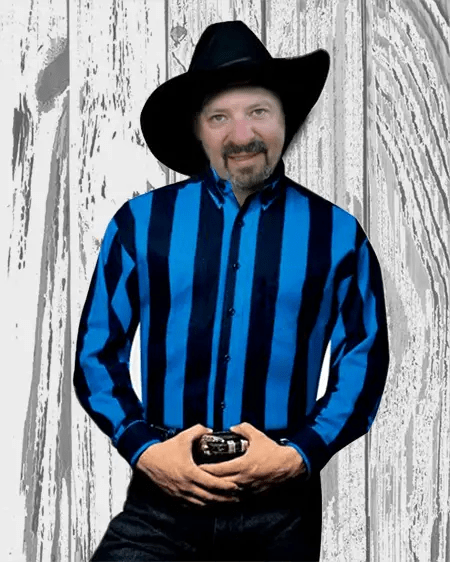
Anyway, here we are in this tiny bar, me in my deerskin cowboy boots, blue and black Garth Brooks cowboy shirt and a black ten-gallon hat. Naturally, my girlfriend insisted I go up and sing her a song. She even picks out the Randy Travis’ classic “Diggin’ Up Bones” and me being a fool in love agrees to make an arsehole of myself for all to see. For my efforts, I may have spent some time in the back seat of a fogged-up car before hopping on the train back to Hogtown, but my memory is a bit fuzzy.
So here is this fool on a makeshift stage crooning to the ball boppin’ across the screen of the Karaoke display. The room is full of about 25-30 mostly Aboriginal Canadians from the nearby reservation. When the music finally ends and I set the microphone back on the stand the room erupts into applause, a few so moved they even jump to their feet to give me a standing ovation. Later on, as we were sitting at our table sippin’ on Molson Canadian, the only beer they served, one of the patrons who was clearly three sheets to the wind stopped by our table and insisted I should consider starting a career as a singer/musician, he even suggested he could talk to the owner of the bar to get me a gig for a few nights.
FYI, you will be happy (or at least your ears will) that my singing career has remained largely confined to an empty car or the bathroom shower!!!
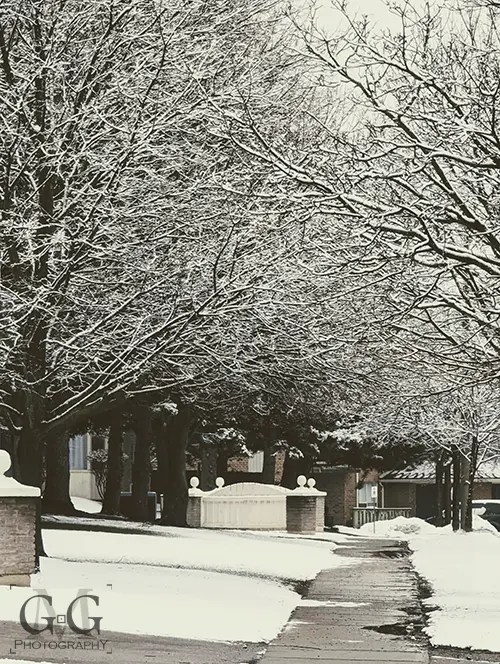
This was the last image on my phone for March and I am hoping it is winter’s last gasp for 2023. I guess time will tell.
Image was captured in March 2023 in my neighbourhood, Waterloo, Ontario Equipment: Google Pixel 7 Pro (Rear Camera) Settings: 19mm | 1/110 sec. at ƒ/3.4 | ISO12600. No additional processing. Watermark added via Adobe Lightroom/Photoshop.
Every week Fandango over at This, That and the Other posts a provocative question. This week’s question deals with memory and the things we believed to be true. Although my post does not deal in absolute truths and likely veers from Fandango’s original concept, it does speak to a realization of something I believed would happen but never did. This week’s question is…
“Have you ever been sure that you knew something to be true only to find out that what you thought you knew to be true was, in fact, not true? If so, what was it and how did you find out that it wasn’t true?”
Canada has always been divided along language and religious lines. A legacy left by the British who conquered the French on the plains of Abraham but allowed the French communities to retain their language and customs in Lower Canada, mainly for political reasons back in Europe. The province of Quebec would eventually include most of Lower Canada within its boundary at the time of Canadian confederation in 1867.
Its French heritage has always made Quebec unique within a united Canada, especially when compared to the other nine predominately English-speaking provinces. The most obvious difference is language and this idea of Quebec being a distinct society or a nation much in the same vein as the Aboriginal populations of North America such as the Sioux or Iroquois Nations. The truth is a lot of that rhetoric is a thin veil that the pure laine1francophone minority holds onto like a security blanket, designed to hide their xenophobic and often racist agenda.
I was only five or six, too young to remember the FLQ crisis in the early 70s but I was certainly old enough to remember the first of two referenda held in Quebec’s deluded attempt to (kind of) separate from Canada. I say kind of because many Quebecers believe the Federal government would continue to financially support an independent Quebec and continue to provide the transfer of tax monies collected to the new nation after succession. Bwahhh ha ha…
The first referendum, spearheaded by the Parti Québécois (PQ) and then Quebec Premier René Lévesque was held in 1980. Lévesque was a stereotypical chain-smoking Québécois who grew up in the Gaspé. Although his father was a prominent lawyer and he did not grow up impoverished, he was raised in a region of Quebec where the French-speaking population was dirt poor compared to the English, most of whom were descendants of British Loyalists who had fled the American Revolution. This would have a profound effect on his life and his politics. Quebec’s national aspirations would be rejected by 60% of Quebecers in that first bid for independence and although Lévesque would not live to see it, the province would hold a second unsuccessful vote in 1995.
My Grandmother was French Canadian born and raised in Sainte-Anne-de-Bellevue on the western tip of Île de Montréal. She would marry my Grandfather, an anglophone of English and Irish descent and move to Mississauga, Ontario but she would maintain a deep connection to family in La Belle Province. That first referendum tore her family in two, a line drawn between Nationalist and Federalist allegiances, the wounds not fully healed even to this day.
As a kid, I recall a particular evening at my Grandparent’s house. We were off playing in the kitchen, foyer or den while the adults discussed politics in the living room. Lévesque and the coming referendum dominated the conversation. There may have even been some of the Federalist faction of my Grandmother’s family visiting although my memory is less clear on those facts.
What I do remember is my Grandfather getting very heated and stating rather emphatically that René Lévesque would realize his treachery and in some display of remorse for his actions hang himself. I admit, right up until his death of heart failure in 1987 I fully expected to wake up to the news of Lévesque being found, hanged by his own hand from the rafters of his garage. I know a weird fascination for a kid but the memory of my Grandfather’s words have stuck with me for almost half a century.
As for Lévesque, friends and foes alike remember him as a giant of Canadian/Quebec politics. In my view, he was nothing more than a traitor to the values this country holds dear. Separation for Quebec seems more unlikely today than ever. Immigrants continue to flock to Canada and settle across the country. Many hold deep-seated allegiances to the federal government that provided asylum from whatever horrors they left behind in their native lands. As such they tend to have federalist leanings and as the population dynamic continues to evolve in Quebec federalist voices continue to outweigh the desires of the separatists.
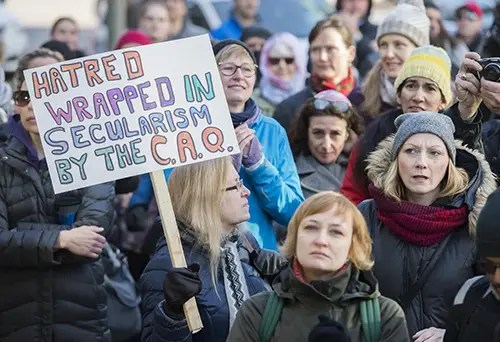
Still, many of the policies born from the early PQ and the separatist movement are present in modern-day Quebec as is evident in Bill 96, yet another attempt to eradicate secondary languages and in particular English from the province and the blatantly racist Bill 21 designed to force public servants to remove all vestiges of personal religious symbolism in provincial workplaces.
Although the bill is written to include the removal of all religious symbolism, and sold to the public as an effort to separate church and state. It is advertised as promoting secularism in provincial institutions, but in reality is an attack on minority groups in the province, especially those who have more outwardly visible religious attire such as turbans or hijabs and will have little effect on the province’s Catholics. Most Christian symbolism such as crosses or crucifixes are normally small or hidden beneath clothing and the line between their religious roots and secular prominence have long since blurred making it less likely to be enforced.
Note: 1. The French term pure laine (lit. ’pure wool’ or ‘genuine’, often translated as ‘old stock’ or ‘dyed-in-the-wool’), refers to Québécois people of French-Canadian ancestry, especially those descended from the original settlers of New France who arrived during the 17th and 18th centuries. Citation: Wikipedia.








 Greg's Blog